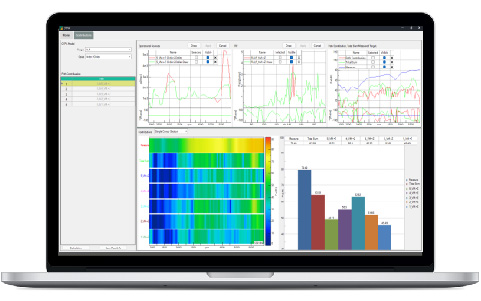
Transfer Path Analysis (TPA) is a core NVH technique for identifying vibration and noise issues. Adopting the source-path-receiver model, it quantifies each transmission path’s contribution to target responses and sees extensive application in automotive development.
During vehicle R&D, engineers regard the powertrain as the excitation source and noise at the driver’s ear as the target response. They measure frequency response functions and extract operational loads to calculate noise contributions from each mounting path. The dominant path with the largest contribution can be identified to optimize mount stiffness and resolve low-frequency booming inside the cabin. For compound interior noise at high speeds, airborne TPA distinguishes tire noise and wind noise contributions for targeted noise reduction.
Operational Transfer Path Analysis (OTPA) eliminates the need for extra excitation force measurement, supporting fast on-site troubleshooting and higher R&D efficiency.
Phone:010-5997700
Fax:010-68018063
E-Mail:info@landtop.com
Address:2/F, LeafIN hotel Hotel, No.2Minzuyuan Road, ChaoyangDistrict, Bejing, 100101


TOP







 Please leave your contact information, and we will get back to you as soon as possible!