






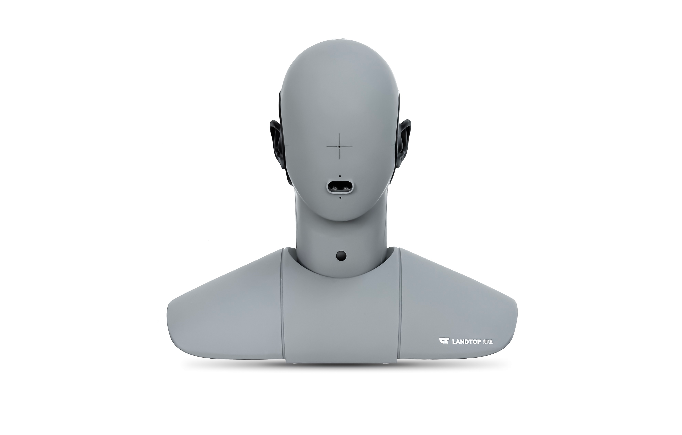
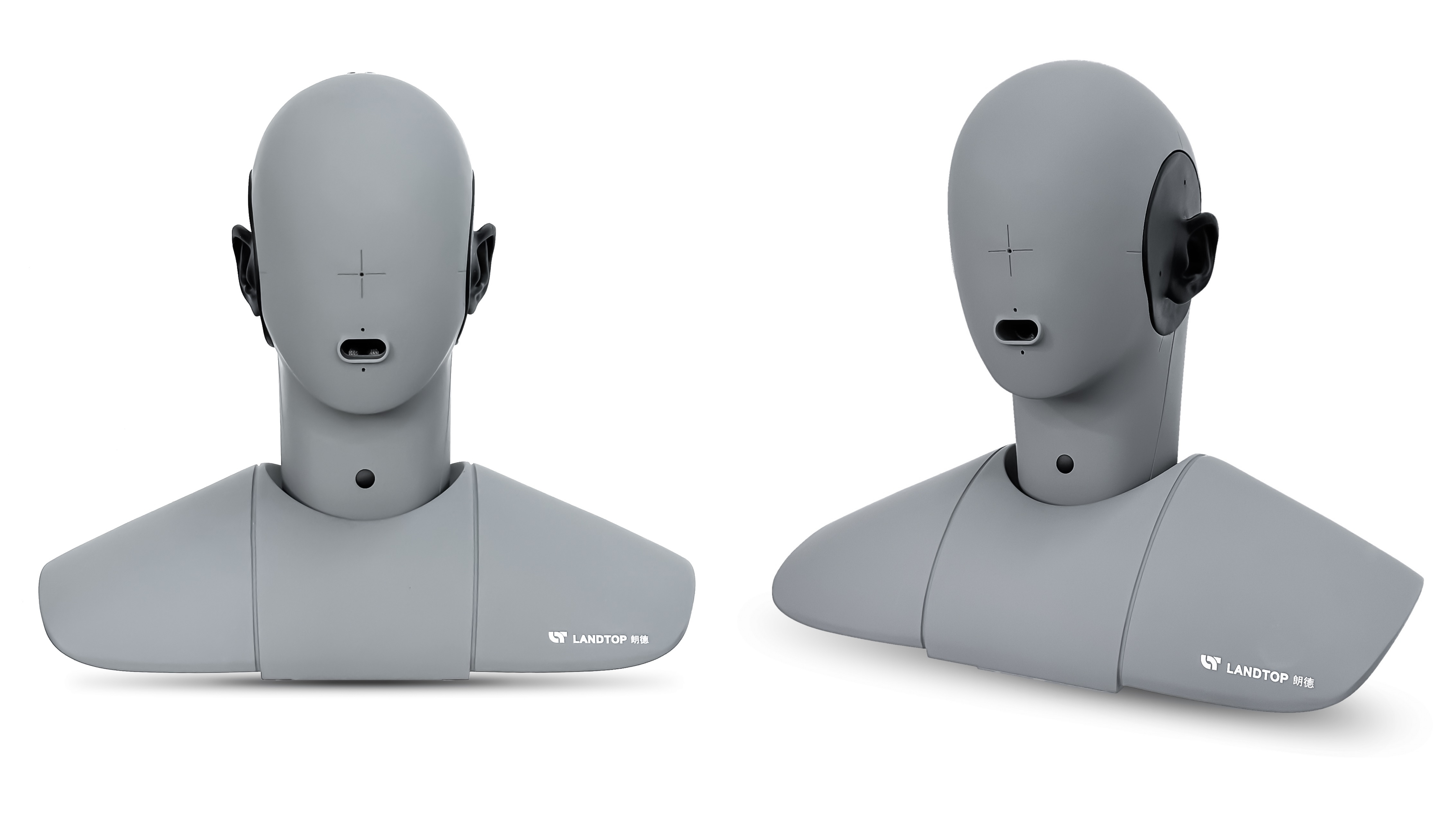
Compliant with ITU-T P.57 and P.58 standards, the LHT features an anatomically accurate artificial head structure capable of capturing authentic acoustic characteristics of voice interaction terminals. Modularly configurable, it can be equipped with left and right ears (complete with ear simulators) and an artificial mouth.
To
fully cover the full frequency range of human speech, the artificial mouth
reproduces the complete audio spectrum with minimal distortion, supporting
ultra-wideband and full-band testing as specified in 3GPP TS 26.131 and TS
26.132.
System Description
■ LHT is designed for testing all kinds of acoustic transducers. By simulating human sound diffraction and reflection characteristics, it realizes transmitting-end and receiving-end voice tests, and meets all communication acoustic test requirements under actual application scenarios.
■ The artificial ear consists of pinna and ear simulator. The pinna is designed per ITU-T P.57 Type3.3, ideal for in-ear devices such as in-ear headsets and hearing aids. The ear simulator complies with IEC 60318-4.
■ The artificial mouth fully conforms to ITU-T P.58 with consistent free-field transmission characteristics at all test positions.
■ The integrated shoulder and torso simulator accurately restores human body acoustic diffraction and reflection properties, suitable for far-field acoustic performance testing. Its geometric dimensions strictly follow ITU-T P.58 and satisfy all head profile tolerance requirements.
■ Each LHT is equipped with BEQ digital equalizer, allowing signals collected by artificial ears to be switched among DF, FF and ID sound fields.
Main Features
■ Anatomical pinna simulators (left
& right) compliant with ITU-T P.57 Type3.3
■ Built-in BEQ digital equalizer
supporting DF, FF and ID sound fields
■ Artificial ear frequency response
range: 3Hz~20kHz
■ Ear simulator compliant with IEC
60318-4 (2010-01)
■ Compatible with human auditory
perception and conventional measurement methods
■ Artificial mouth fully compliant with
ITU-T P.58
■ Artificial mouth frequency response range: 50Hz~20kHz, supporting ultra-wideband and full-band real human voice simulation testing



 Please leave your contact information, and we will get back to you as soon as possible!