






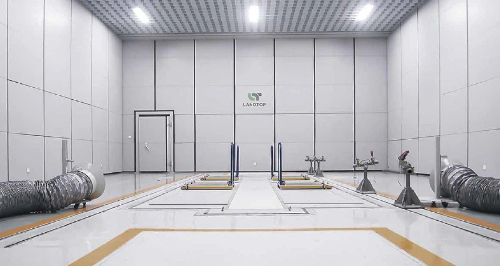
In line with research and
measurement demands, the core technical parameters of an anechoic chamber
consist of cut-off frequency, free-field range and background noise level. The
cut-off frequency refers to the lowest usable frequency that can be measured
accurately inside the chamber; the free-field range stands for the maximum
acoustic space available for precise measurement; background noise determines
the minimum measurable sound level. For acoustic measurements without
correction, the background noise of the anechoic chamber shall be at least 10
dB lower than the sound source under test.
To construct a free sound
field indoors, sound-absorbing wedges are conventionally adopted as the basic
absorptive structure. In accordance with classic acoustic theories, the length
of a wedge needs to equal one quarter of the wavelength corresponding to the
cut-off frequency. For example, a cut-off frequency of 100 Hz requires 850 mm
long wedges, while a cut-off frequency of 50 Hz calls for wedges as long as
1,700 mm. Although certain technical optimizations can moderately shorten wedge
length, the scope of reduction is limited. For a 100 Hz cut-off frequency,
wedges still need to be approximately 750 mm long even after adopting various
optimization techniques. Oversized absorptive structures occupy massive indoor
space. Therefore, drastically reducing absorber thickness and developing
subwavelength structures to meet sound absorption criteria have long been key
targets of technological advancement, and research on acoustic metamaterials
and metastructures keeps advancing toward this objective.
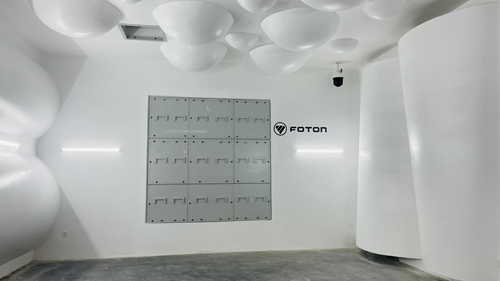
For the design and
construction of our anechoic chambers, we adopt self-developed, patented
fiber-free sound-absorbing structures ASA and BCA. BCA is a planar composite
resonant sound absorber with an overall thickness of 350 mm; ASA is an
asymmetric sound absorber with a total thickness of 650 mm. Both structures can
satisfy the sound absorption requirements of anechoic chambers with a low
cut-off frequency down to 50 Hz.
Fundamental principles of room
acoustics prove that the geometric dimensions of a room exert a critical
influence on its internal sound field. In our anechoic chamber design, the room
geometry is optimized based on room acoustic theories, granting the chamber
inherent superior acoustic performance.
For every anechoic chamber design, validated simulation software is utilized to carry out sound field simulation and calculation, so as to inspect the deviation between sound field attenuation characteristics inside the chamber and the ideal free field. This practice significantly cuts down engineering risks and ensures the finished anechoic chamber meets the designed acoustic performance indicators.
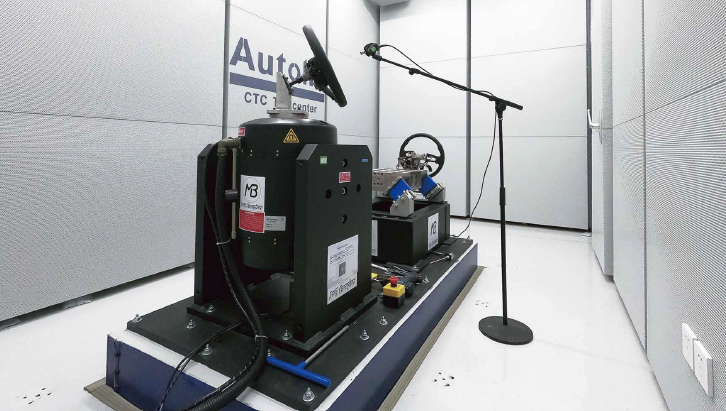
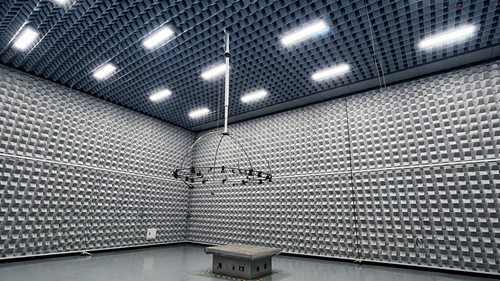
Semi-Anechoic Chamber of Autoliv Automotive Safety Systems
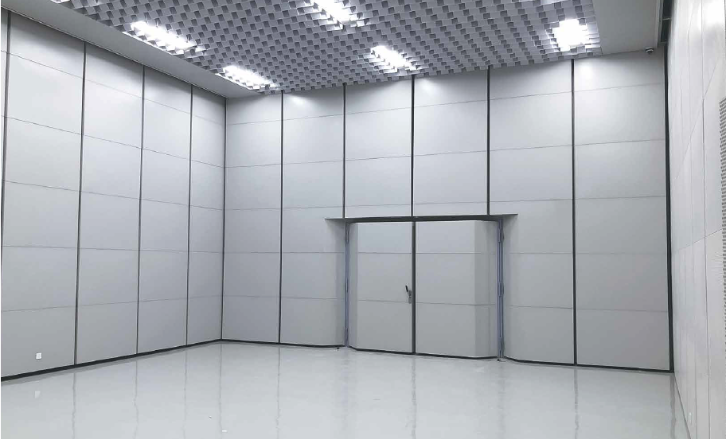
Semi-Anechoic Chamber of BAIC New Energy
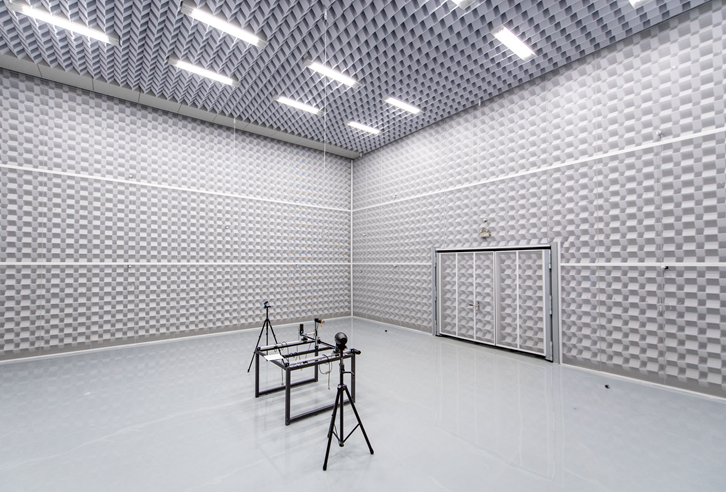
Semi-Anechoic Chamber, Acoustics Center of Zhijiang Laboratory



 Please leave your contact information, and we will get back to you as soon as possible!